| |
Address |
9426 Pflumm Old Towne Lenexa, Kansas 66215 |
|
| Telephone |
(913) 541-0478 |
| Fax |
(913) 541-1741 |
|
E-MEOW News
Summer 2007 -Baseline Blood Work -A Letter From Dr. Schomacker -Summer Vacation at the Cat Clinic of Johnson County -Keeping Cats Indoors Isn’t Just for the Birds -Feline Heartworms
Summer 2005 - Win the War on Fleas - Common Cat Hazards - Myths About Spaying & Neutering - Senior Americans: Older Americans & Mature Pets
Spring 2005 - Keep Your Cat Safe At Home: HSUS's Safe Cat Campaign - Bringing an Outside Cat Inside - Keeping Your Cat Happy Indoors - Choosing a Pet Sitter
Winter 2004 - Did you Know? Poinsettias - Mushrooms - Keep Cat from Terrorizing Christmas Tree - Poison Proof Your Pet's Home - Can Pets Sense Pregnancy? - Antifreeze Change can be Dangerous for Pets
Fall 2004 - Protect Your Pets - Claws: Controlling the Damage - Full House: Living Peaceably with Dogs & Cats - Fight Animal Cruelty - 1st year cat cost estimate - What to do for a Poisoned Animal
Summer 2004 - Safety tips for a flea free summer - Counter Intelligence - American Humane Conference - Finding a Cat that Fits your Family
Spring 2004 - Traveling with your cat - Feline First Aid Kits - When You Can't Take Them With You - Air Travel With Your Cat - Pets can get motion sickness too
Winter 2004
- "Winterizing" Your Pet Is Important In Cold Weather - Feline Dental Health - Not Just Cat Teeth: Dental Hygiene and Your Cat - Avoiding Pets May Not Prevent Allergies - The Growing Shape of Pets - Tips for Treating Cat Allergies - Declawing: Imperative or Inhumane?
Fall 2003 Newsletter - Finding the Right Cat Breed for You - Make Kitty's Home His Castle - Winning The Cat Carrier Wars: 6 Tips - Help for Fat Cats
FLEA & TICK PREVENTION CAUTION! We have treated quite a number of cats this season for drug reactions related to over-the-counter flea and tick preventives. Treating your cats or kittens with some of the over-the-counter products can sometimes be a waste of money, but most importantly may lead to lethal toxicity. NEVER use flea products labeled "for dogs" on cats. One example is spot-on flea products for dogs. These products often contain high concentrations of permethrin, an insecticide used in flea and tick control that can be deadly to a cat, even in very small doses. The common signs of permethrin toxicity in cats include generalized tremors, muscle fasciculation (small local contractions of muscles, visible through the skin) and seizures. These symtoms can develop within hours or may not appear for up to 48 hours. To be safe, please use only the products specifically recommended for your cat. We have a full stock of preventives such as Advantage, Revolution and/or Frontline Plus, and can recommend one of these for your particular cat's lifestyle next time you're in. For more information, see www.apcc.aspca.org.
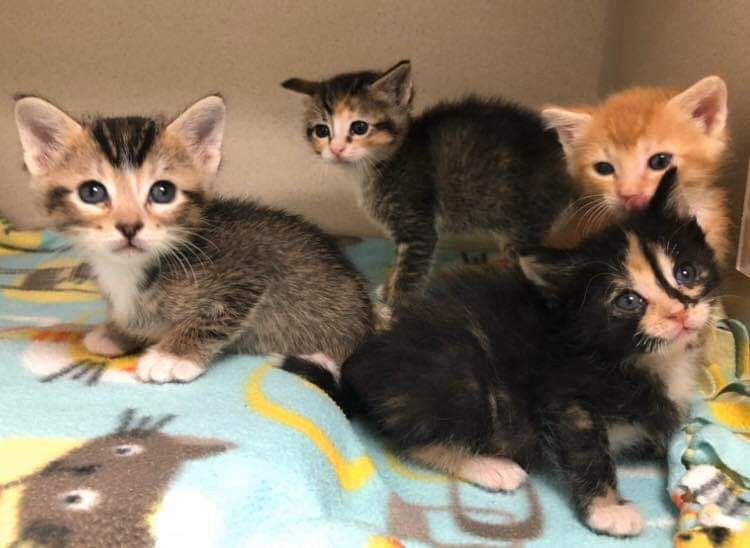
KITTENS, KITTENS - KABOODLES OF KITTENS! We have been seeing oodles of new kittens this Spring! So, we thought you might like some ideas on introducing a new cat or kitten to those who have already taken up residence with you. Like the little sign in our lobby says, "Cats are like potato chips, one is never enough!"
Most cats find change very stressful and adding a new cat/kitten to your home is definitely a change for the one(s) already there. This doesn't mean you shouldn't do it. However, it does mean you need to introduce the newcomer slowly and make the change more gradual for everyone involved to lower the stress level. This doesn't guarantee success, but it does improve the odds. The following pointers may prove helpful:
1) Confine the new kitty to it's own room with food, water and litterbox for 5-7 days. This is important for 2 reasons. First it acts as a quarantine period. No matter how healthy your new kitty looks or acts, it may be incubating a disease. In addition, because he/she will be stressed coming into a new home, his/her immune defenses may be lowered making it more susceptible to diseases it was successfully fighting off before. Second, it allows your resident cat to adjust to the fact that there is an "intruder" in the home, but not feel threatened by visual contact.
2) During the "quarantine period" take some time to confine your resident cat and allow the newcomer to explore different areas of your home. With your resident cat confined, the new kitty can explore without fear of being confronted before he/she is ready. You can also use washcloths to transfer scents between the new kitty and the resident kitty. Each day, rub a dry washcloth on one kitty's cheeks and then rub the washcloth on the other's back or sides. Don't wash the cloth during this quarantine period.
3) As long as your new kitty remains healthy after 5-7 days, you are ready for the next step. Place the new kitty in a carrier in the middle of the living area and allow your resident cat free roam in the room. The cats now have contact, but under protected circumstances. Don't be surprised to see some growling, hissing or posturing. This step may take a few hours or a few days.
4) Once you are comfortable with how the cats are interacting in step 3, you may begin allowing direct, yet supervised interaction. Starting with short periods and gradually increasing time spent together. Continue to confine the new kitty when you are away from home until you feel comfortable with how the cats are getting along.
Most important, BE PATIENT and don't expect too much. Some cats will become the best of pals, but others will simply learn to tolerate each other. That's OK. The purpose of these guidelines is to minimize the chances of civil war in your home! GOOD LUCK!
DO YOU HAVE THE MAKINGS OF A FELINE FIRST AID KIT? First of all, there is really no substitute for a phone call or visit to your veterinarian. However, if you have the following items on hand, it may be helpful.
1) "Rectal" thermometer, any thermometer will work, as long as it is well-labeled "for rectal use only" -- NOTE: Cat's normal temperature is 100.5 to 102.5 degrees F. 2) Lubricant: vasoline or KY jelly (to place on thermometer for insertion) 3) Small blanket or towel 4) Cotton balls 5) Alcohol can be applied to foot pads when temperature registers 105.0 degrees F. 6) Dawn dishwashing detergent 7) Styptic powder - for bleeding toenail 8) Syringe or eye dropper - for administering oral medication
THE FOLLOWING ITEMS SHOULD ONLY BE USED "AFTER" CONSULTING A VETERINARIAN:
1) Hydrogen peroxide 2) Saline solution 3) Pepto Bismol liquid 4) Karo syrup or honey
NEVER GIVE OVER-THE-COUNTER PAIN RELIEVERS, ESPECIALLY TYLENOL, TO A CAT!!
|
|


|